
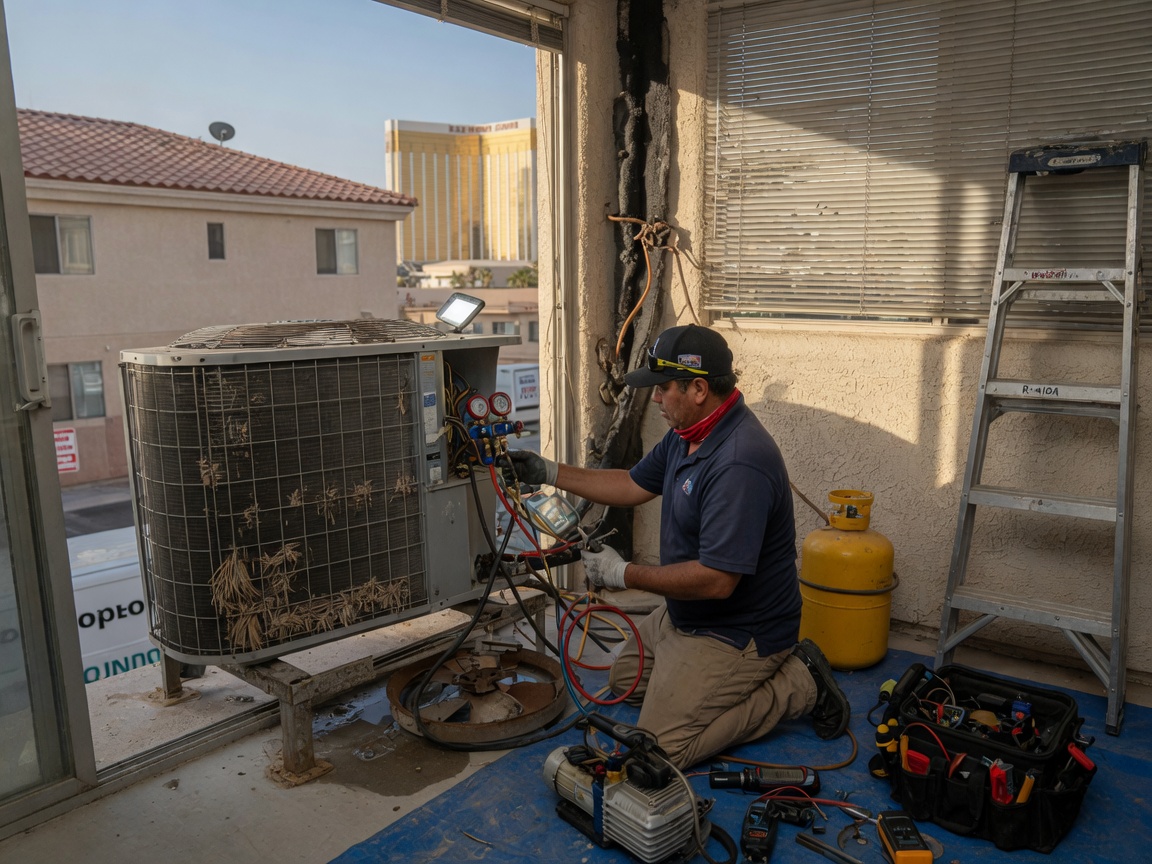
Las Vegas summers push air conditioning systems hard, with daytime highs often exceeding 105 degrees and fine desert dust accumulating on coils and filters. Homes in neighborhoods like Summerlin and Centennial Hills frequently have units installed during the building booms of the 1990s and early 2000s, where original compressors and capacitors now face repeated thermal stress. Technicians must account for low humidity that accelerates wear on moving parts and the alkaline soil conditions around the valley that can corrode outdoor cabinets faster than in coastal regions.
Repair calls in areas such as the Arts District and Downtown Las Vegas often involve compact rooftop or side-yard units squeezed into tight spaces near high-traffic zones, requiring extra attention to vibration isolation and electrical connections. In Spring Valley and Sunrise Manor, many single-story tract homes share similar duct layouts that trap dust, leading to restricted airflow and higher head pressures. Proper diagnosis includes checking refrigerant charge against manufacturer specifications rather than relying on pressure alone, because extreme ambient temperatures skew gauge readings.
Edge cases include units near the Las Vegas Strip or Mandalay Bay that run continuously for guest comfort, shortening component life, and systems in Lone Mountain where wind-blown sand from nearby desert terrain increases filter changes. Code compliance in Clark County requires proper recovery of refrigerant and correct electrical disconnect placement. Homeowners in Henderson and North Las Vegas sometimes overlook the impact of mild winters on reversing valves, which can stick after months of inactivity.
Technician insight
In Las Vegas, the thing that catches most people out with Air Conditioning Repair is how quickly fine desert dust bypasses standard filters and packs the evaporator coil in homes built before 2005, especially in Spring Valley and Sunrise Manor where original ductwork was never oversized for today’s heat loads.
Failed Capacitor on a 2002 Unit in Enterprise
Homeowner reported the outdoor fan running but no cooling after a 110-degree afternoon. We found a bulging dual-run capacitor and high amp draw on the compressor. Replaced the capacitor, verified pressures against the unit’s rating plate, and confirmed supply air at 58 degrees before leaving.
Air Conditioning Repair Services We Offer
✓Compressor Replacement
Swap failed compressors in residential split systems common to Summerlin and Enterprise homes, restoring cooling capacity during peak summer loads.
✓Refrigerant Leak Detection and Repair
Locate and seal leaks in copper linesets exposed to alkaline Las Vegas soil and high UV, then recharge to factory specifications.
✓Capacitor and Contactor Service
Replace weakened start capacitors and corroded contactors that fail from repeated heat cycles in Clark County attics and garages.
✓Coil Cleaning and Airflow Restoration
Remove packed desert dust from evaporator and condenser coils to lower head pressure and improve efficiency in older Sunrise Manor homes.
✓Thermostat and Control Repair
Diagnose and fix smart and mechanical thermostats that misread temperatures due to direct sun exposure common near the Strip and Fremont Street.
Air Conditioning Repair Cost in Las Vegas, NV
| Service | Typical Range | What Affects It |
|---|---|---|
| Diagnostic Visit | $99–$150 | Covers travel within Clark County and basic testing; higher for after-hours or complex rooftop access. |
| Capacitor Replacement | $180–$320 | Includes part and labor; dual-run capacitors on larger systems cost more. |
| Refrigerant Leak Repair | $350–$650 | Depends on leak location and amount of refrigerant recovered and replaced. |
| Compressor Replacement | $1,400–$2,200 | Varies by tonnage, accessibility, and whether the system requires a hard-start kit. |
Ranges are typical for Las Vegas, NV and confirmed with an exact written quote before any work starts.
How it works
- 1
Arrival And Safety Check
Technician arrives during posted hours, verifies power at the disconnect, and confirms the system is off before any inspection begins.
- 2
System Diagnosis
Measure pressures, temperatures, and amperage draw while accounting for current outdoor conditions in the Las Vegas valley.
- 3
Component Repair Or Replacement
Address the identified fault using OEM or equivalent parts suited to desert duty cycles and reinstall with proper torque and sealing.
- 4
Performance Verification
Run the system through a full cycle, confirm supply and return temperatures, and document readings for the homeowner.
Pricing
Most air conditioning repair visits start with a diagnostic charge that is credited toward any approved repair work.